

Two patties. One pound of beef, minimum. The choices happen around that foundation.
Garden options give produce more room and the guest more choice. Special orders turn those choices into a clear ticket, a deliberate build and a confident handoff. The work is deciding what the kitchen can repeat before the line gets busy.
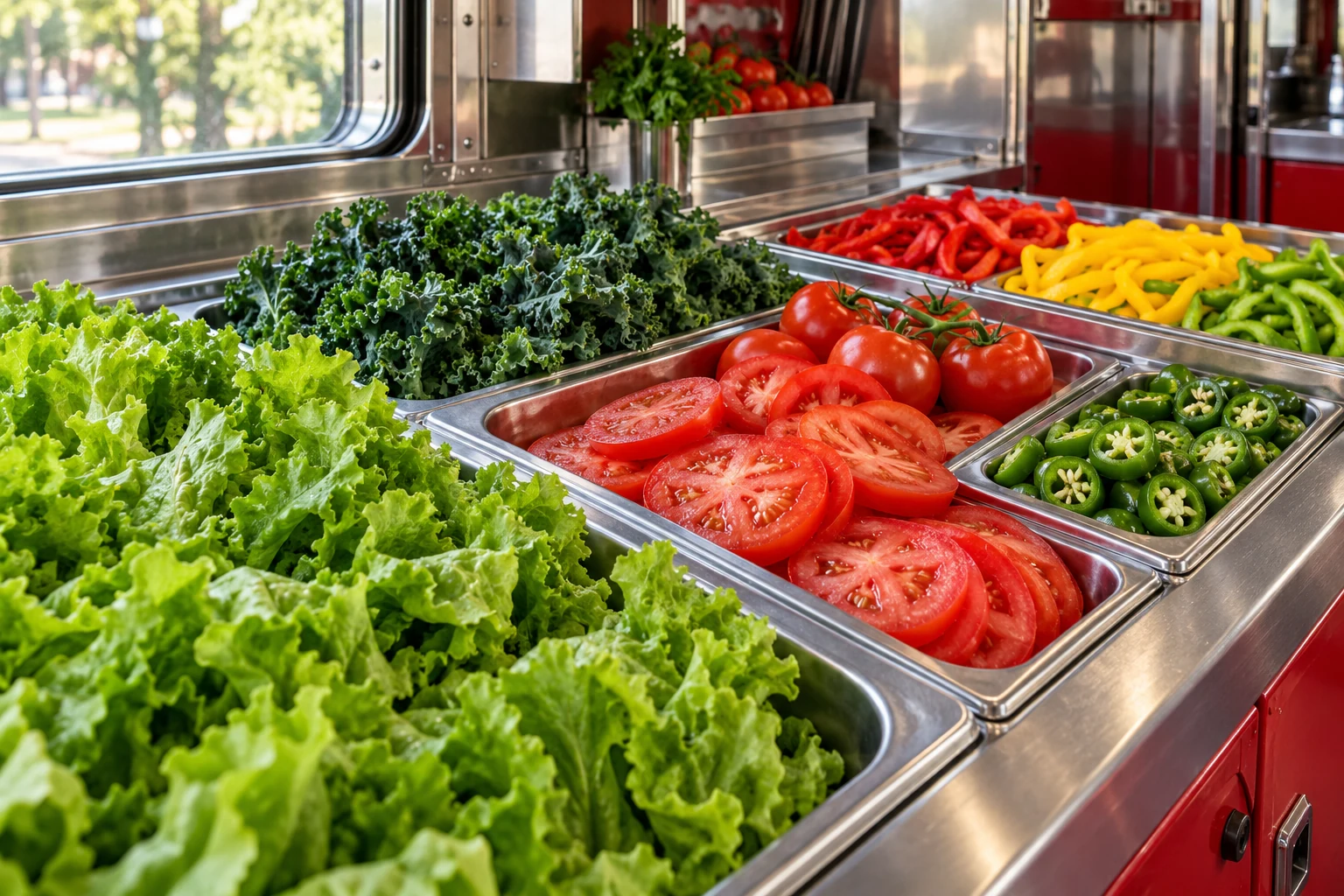
Burger Lab development note: These are proposed menu options and service practices. The vegetable photograph is an editorial concept; individual produce options still require menu approval. Portions, pricing and procedures require approval and testing before use in a real operation.
01 / CHOICE
A different appetite. The same standard.
Clyde Foods enjoys excess as a brand language. The Colossal Clyde Burger exists for a reason. So does Distilled Water, which Lobos insists remains a meaningful technological achievement.
Operationally, though, customer choice matters. Some guests want less cheese, fewer rich components, more produce, sauce on the side, or simply a meal that fits what they want that day. A useful menu gives those customers a deliberate path instead of making them construct a completely different product through a series of removals.
The full Clyde Burger keeps its identity: two half-pound patties, six cheese slices and an egg. Every approved burger variation keeps the two-patty, one-pound minimum, measured before cooking. Customize the toppings without shrinking the beef standard.
02 / GARDEN BUILDS
Make the alternative a real build.
Garden is Clyde Foods shorthand for the intentionally vegetable-heavy branch of the menu. It is a brand name, not a nutrition claim. The point is to give customers a clearly defined alternate build without pretending lettuce transforms the laws of physics.
Two half-pound patties remain the minimum. Garden choices change the produce and approved toppings, not the amount of beef.
Offer fewer cheese layers when requested instead of treating the six-slice build as irreversible law.
A fried egg adds richness and timing complexity. Making it removable is an easy, understandable customization.
Guests can control how much they use. The Clyde Sauce recipe remains confidential, while required allergen, ingredient, nutrition, and other product information will still be provided accurately whenever applicable law requires it.
Extra lettuce, tomato, jalapeños or other approved produce can change the balance of the burger without creating a new cooking station.
Diet beverages and water are simple, visible options that do not burden the hot line.
Garden does not automatically mean vegetarian, vegan or allergen-free. These burger variations retain the beef foundation. Describe what is in each approved build; do not let a friendly menu name do the work of an ingredient list.
Lettuce, tomato and jalapeños connect to the established build. Kale and sweet peppers are additional Garden ingredients to evaluate for texture, prep requirements and a clearly defined portion before offering them. All beef continues to meet the grass-fed, 85/15-or-leaner Clyde specification.
03 / THE TICKET
The register should send a clear instruction.
Every approved modification should have a defined POS button, kitchen-display label, portion standard, and price rule if applicable. "Just type a note" does not scale well when a line of orders arrives at once.
D4 Prime prefers a finite modification system: enough choice to be useful, not enough combinations to turn every burger into a custom engineering project.
Use one clear field for each choice: cheese portion, egg, produce, jalapeños and sauce placement. Make removals visible to both the cook and assembler. Agree on any applicable price before payment, and repeat the final choices to the guest.
04 / NAMED ORDERS
Name the build before the rush.
A well-designed Garden option can be easier to execute than an order that says "Clyde Burger, no this, no that, half of something, extra something else." If demand justifies it, a named build with its own standard improves speed, training, costing, and order accuracy.
The key is honesty: Garden describes the Clyde Foods build style only. It should not be presented as a calorie, health, weight-control, or other nutrition claim.
Give an approved Garden build its own recipe card and POS entry. Keep a small, explicit list of available changes beneath it. When a guest asks for the same alternative again, the second cook should not need to reconstruct the first cook’s interpretation.
05 / PORTIONS
Every topping needs a precise portion.
A Garden build becomes inconsistent if one cook uses two ounces of cheese and another uses four. Garden products need actual portion standards just like the flagship burger.
Define raw patty weight, cheese slice count and weight, lettuce and tomato portions, drained jalapeño quantity and sauce-cup fill. “Extra” needs a measured amount too. Otherwise the same button becomes two different burgers on two different shifts.
Keep the prep familiar: the same approved beef, the same clean produce station and the same ingredient standards. A modified order should not become the place where tired lettuce or inconsistent portions go.
06 / WHAT FITS
Offer the choices the kitchen can deliver.
Removing an egg is reasonable. Sauce on the side is reasonable. Extra lettuce is easy. A request that forces the crew to abandon the standard cooking line, monopolize the griddle, use equipment in an unapproved way, or create a product the kitchen has never trained should not automatically be accepted simply because the customer asked.
A professional menu defines what can be modified and trains the team to say both yes and no consistently.
For jalapeños, use a clear include/omit choice and an approved extra portion if offered. For sauce on the side, use a covered portion cup that stays with the correct ticket. If a request falls outside the trained options, explain what the kitchen can make before accepting it.
07 / ALLERGIES
An allergy request takes a separate route.
Ordinary customizations and food-allergy requests are different. Removing cheese, egg, or sauce changes the build, but does not establish that the remaining ingredients or finished meal are free of the relevant allergen. Shared utensils, prep surfaces, griddles, fryers, frying oil, storage, and handling can introduce allergen cross-contact.
In any real food-service operation, an allergy request should be flagged and referred to a trained responsible person before it is accepted. Ingredient and supplier information, preparation methods, and cross-contact controls must be checked for the specific request. If the kitchen cannot safely accommodate it, staff should explain that limitation clearly rather than promise an allergen-free meal. Order readback confirms the requested build; it does not replace allergen controls.
FDA guidance on allergen removal and transfer in retail food establishments →
08 / THE HANDOFF
Read it back. Check it out.
At handoff, the order should be checked against the ticket: correct burger, correct approved removals or additions, correct sides and drink, correct packaging. The more modified the order, the more valuable that final check becomes.
- At order entry: repeat the named build and every addition or removal. Clarify anything ambiguous before sending the ticket.
- Before cooking: confirm the two-patty minimum, cheese amount and egg choice. Carry the ticket through the cook and assembly stages.
- Before closing the bun: check lettuce, tomato, jalapeños and sauce against the order. Correct a mistake through the approved remake procedure.
- At handoff: identify the order and repeat its key changes. Confirm the sauce cup, sides, drink and packaging belong to that guest.
For allergy orders, the responsible person’s approved checks still apply. Simply removing a mistaken topping is not a substitute for that process.
09 / QUALITY
Make every variation worth ordering.
D4 Prime has no interest in building a "Garden burger" that tastes like a disciplinary action. Every approved variation still needs the full beef minimum, properly melted cheese in the chosen amount, crisp lettuce, ripe tomato, correct seasoning, and a build that looks intentional.
Trial the alternative as a complete meal. Check the first bite, the last bite and how well the stack holds together at handoff. More lettuce should add crunch; tomato should add flavor; jalapeños should deliver the intended heat without a puddle of brine.
Use the same cheese, lettuce, tomato and jalapeño standards as the flagship. The toppings can change; the beef minimum and the care stay.
10 / CLYDE SAUCE
Sauce on the side. Recipe under wraps.
No recipe clues. No ratios. No supplier clues. No "healthier version" clues. Required food information is a separate compliance obligation and will be provided accurately when applicable law requires it; that does not make the Clyde Sauce recipe public.