

Before the cheese melts, before the egg hits the steel, before anyone reaches for Clyde Sauce, the beef has to earn its place in the burger.
Clyde’s Burgers uses grass-fed beef, with an 85/15 lean-to-fat standard or leaner. Each patty starts at eight ounces; every double starts with one full pound of raw beef. That is too much of the sandwich to leave to a bargain-bin substitution.
Burger Lab development note: These are the Clyde concept’s ingredient standards and proposed kitchen practices. Equipment trials and an approved operating procedure are still required before a real service line uses them.
01 / THE PRIMARY INGREDIENT
The standard starts at the source.
Grass-fed is part of Clyde’s beef specification, not a decorative phrase on the menu. The supplier should identify the product and substantiate that claim. Keep the specification, invoices and lot information connected to the beef arriving at the truck; a familiar brand name alone is not enough.
Good burger beef brings clean flavor, a consistent grind, evenly distributed fat and reliable performance to the griddle. Price by itself proves none of those things. We want a product chosen for the burger, then purchased to the same standard every time.
Grass-fed does not, by itself, establish a USDA quality grade or organic certification. Use the claims the supplier can actually support; do not add a badge because it looks good on a case.
Source: USDA FSIS guidance on substantiating animal-raising claims.
02 / READING THE LABEL
Grade, grind and fat tell different stories.
USDA Prime, Choice and Select describe quality characteristics, including marbling. They do not replace a ground-beef specification. A grade describes the source beef; the finished grind still needs its own lean-to-fat ratio, texture and handling requirements.
An 85/15 label means 85 percent lean and 15 percent fat. It does not mean “85 percent quality.” Likewise, “grass-fed” describes how the cattle were fed, not how finely the beef was ground. Read each piece of information for what it actually tells you.
For Clyde, the purchasing question is practical: does this exact product meet the grass-fed requirement, the approved fat level and the cooking standard? D4 Prime’s name is not a USDA Prime claim.
03 / FAT IS PART OF THE RECIPE
85/15 is the starting line.
Clyde’s standard is at least 85 percent lean, with no more than 15 percent fat. An 80/20 grind falls outside that specification. It is not an automatic substitution when the usual case is unavailable.
Fat affects how the patty eats and how much it loses during cooking. The goal is a juicy, beef-forward bite that holds its own under six slices of cheese and a fried egg, without turning the bun into a grease sponge.
A leaner grind can qualify, but leaner is not automatically better. A switch to 90/10 changes the recipe’s behavior and must earn approval in a cook test. Compare tenderness, flavor, cooked weight and the finished double—not just the number printed on the carton.
04 / TEXTURE
The grind should still feel like beef.
Look for an even, distinct grind that forms cleanly without becoming a smooth paste. In development, compare approved samples side by side at the same weight and cooking endpoint. A coarse-looking package is only promising; the cooked texture is the test.
Put the winning specification in writing: supplier, product code, grass-fed documentation, lean-to-fat ratio, grind profile, packaging and lot identification. Record the patty diameter and thickness used in the trial so the next batch starts from the same place.
Keep the meat cold and handling brief. Repeated squeezing and reworking can erase the texture you paid for. The objective is a patty that holds together under a turner and breaks apart easily under a bite.
05 / FIVE POUNDS, PORTIONED PROPERLY
Ten patties. Five Clyde Burgers.
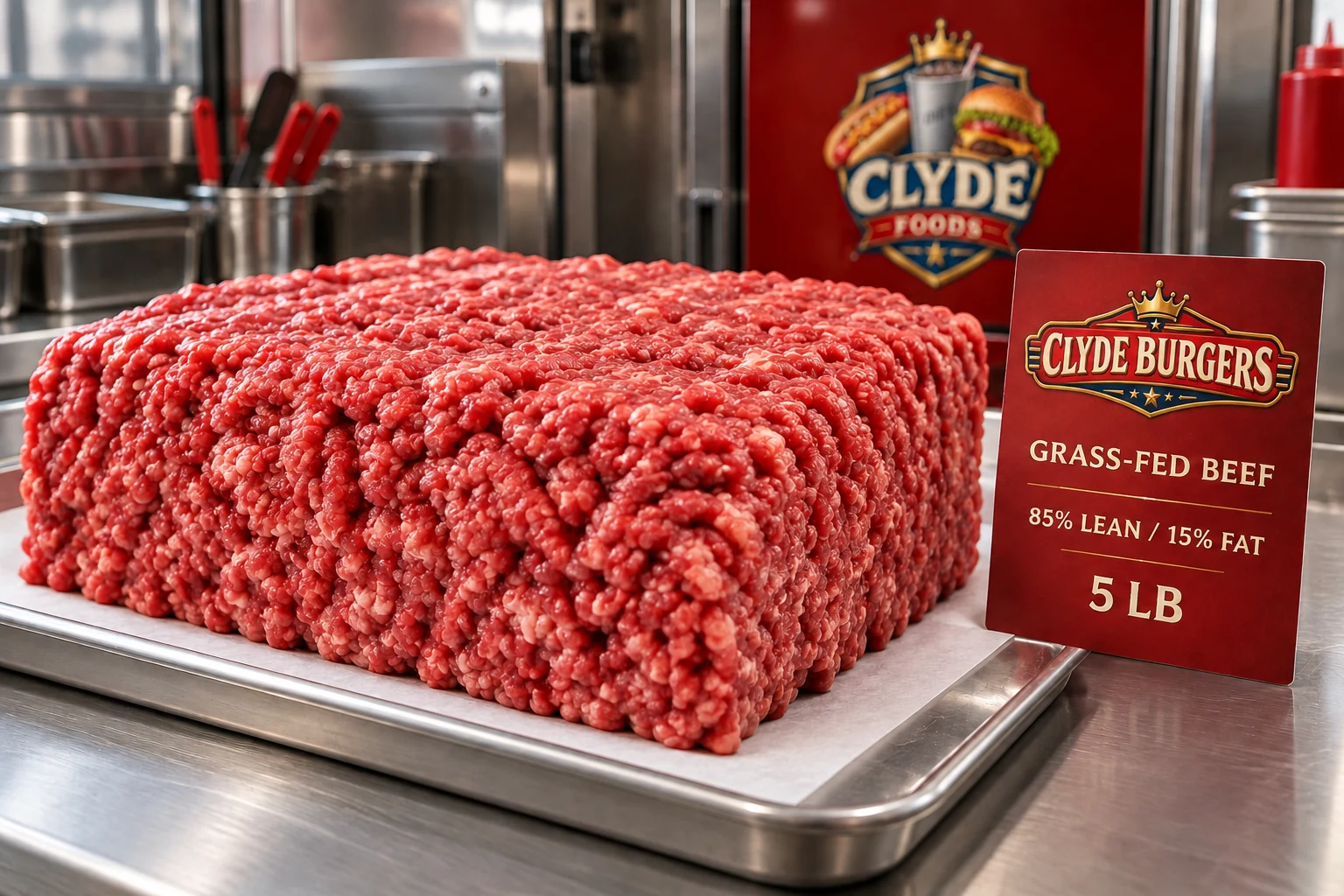
A five-pound pack contains 80 ounces of raw beef: enough for ten eight-ounce patties, or five double-patty Clyde Burgers, before any handling loss. This is portion math, not a promise of cooked yield. Weigh what is actually in the tray.
- Tare the scale. Set a clean food-safe tray or portion paper on the scale and zero it. The paper is not part of the half pound.
- Portion eight ounces. Divide the cold beef into weighed portions. Do not estimate ten equal pieces by eye.
- Shape with a light hand. Bring each portion together gently, keeping the thickness even. The build guide starts around five inches across and three-quarters of an inch thick; confirm those dimensions with the actual grind.
- Protect and refrigerate. Separate patties with suitable food-contact paper, cover and label the batch, then return it to refrigeration. Bring out only the next cooking wave.
Two patties make the burger. Cooking reduces their weight; the half-pound claim here refers to each patty’s raw weight.
“Two half-pound patties is the minimum respectable opening bid. Anything less is just salad with ambition.”
— D4 Prime
06 / THE COLD CHAIN
Protect the beef between every step.
A compact truck needs an orderly raw-meat route: receiving, refrigerated storage, portioning and the griddle. Keep that route away from toasted buns, washed produce and the finished-food pass.
At receiving and storage
- Check delivery temperature, intact packaging, product code, dates and lot identification against the approved receiving specification.
- Use 40°F or below as the beef-storage target. Store raw beef covered, below and separate from ready-to-eat food.
- Label opened and portioned batches. Keep lot information available instead of throwing away the only identifying label.
At the cooking line
- Pull a small working batch; do not leave the full five-pound pack beside a hot griddle.
- Use separate raw and cooked-food tools. Wash hands and clean and sanitize the work area after raw-meat prep.
- Check each patty reaches 160°F internally with a food thermometer. Color and a good crust cannot confirm doneness.
USDA recommends ground beef storage at 40°F or below and cooking to 160°F. The actual truck must follow its approved food-safety procedures and local requirements. USDA ground-beef guidance →
07 / TIME MATTERS
A date is only part of the history.
Know when the case arrived, when it was opened and which batch is on the line. Rotate stock by the approved use-by schedule, with older eligible product used first. Never mix an older batch into a newer one and lose its history.
USDA’s general refrigerated-storage guidance for ground beef is one to two days. Commercial packaging and supplier instructions need to be addressed in the truck’s approved storage procedure; an unopened-pack date should not be treated as permission to hold opened or portioned beef indefinitely.
Do not use smell or a bright red surface as a safety clearance. If the temperature history or identity is uncertain, set the product aside for the responsible manager’s decision under the discard policy.
08 / THE COOK TEST
Give good beef room to brown.
A full half-pound patty brings a substantial cold load to the steel. Stack too many orders onto the surface and the griddle may struggle to recover. Pooling liquid, a weak crust and longer cook times are reasons to reduce the wave.
The 48-inch griddle plan starts a solo cook at four double burgers. Its six-burger layout pairs twelve patties with six eggs and assumes a second person assembling. Those are starting points for equipment trials, not tested production guarantees. The separate 24-inch charbroiler does not add capacity to that drawing.
Trial the approved beef at a consistent starting temperature and eight-ounce portion. Record the surface setting, wave size, time to the safe endpoint, cooked weight, browning and eating quality. A case that shines in a one-patty test still has to work during a realistic wave.
09 / REPEATABILITY
The next case has to earn the same place.
One excellent tasting is a beginning. Repeat the trial across multiple lots and delivery days before approving a regular product. Keep a simple scorecard: raw portion, cooked yield, crust, tenderness, flavor and the burger’s condition at handoff.
Evaluate the beef on its own, then in the full Clyde build. Cheese and sauce should complement it; they should not be doing repair work. The final question is whether both patties still taste like the reason someone ordered the burger.
Approve substitutions before service, not in the middle of it. A replacement must meet the same grass-fed documentation and 85/15-or-leaner requirement, then pass the cooking comparison. Keep the approved product code at ordering and receiving so the standard follows the beef all the way to the truck.