

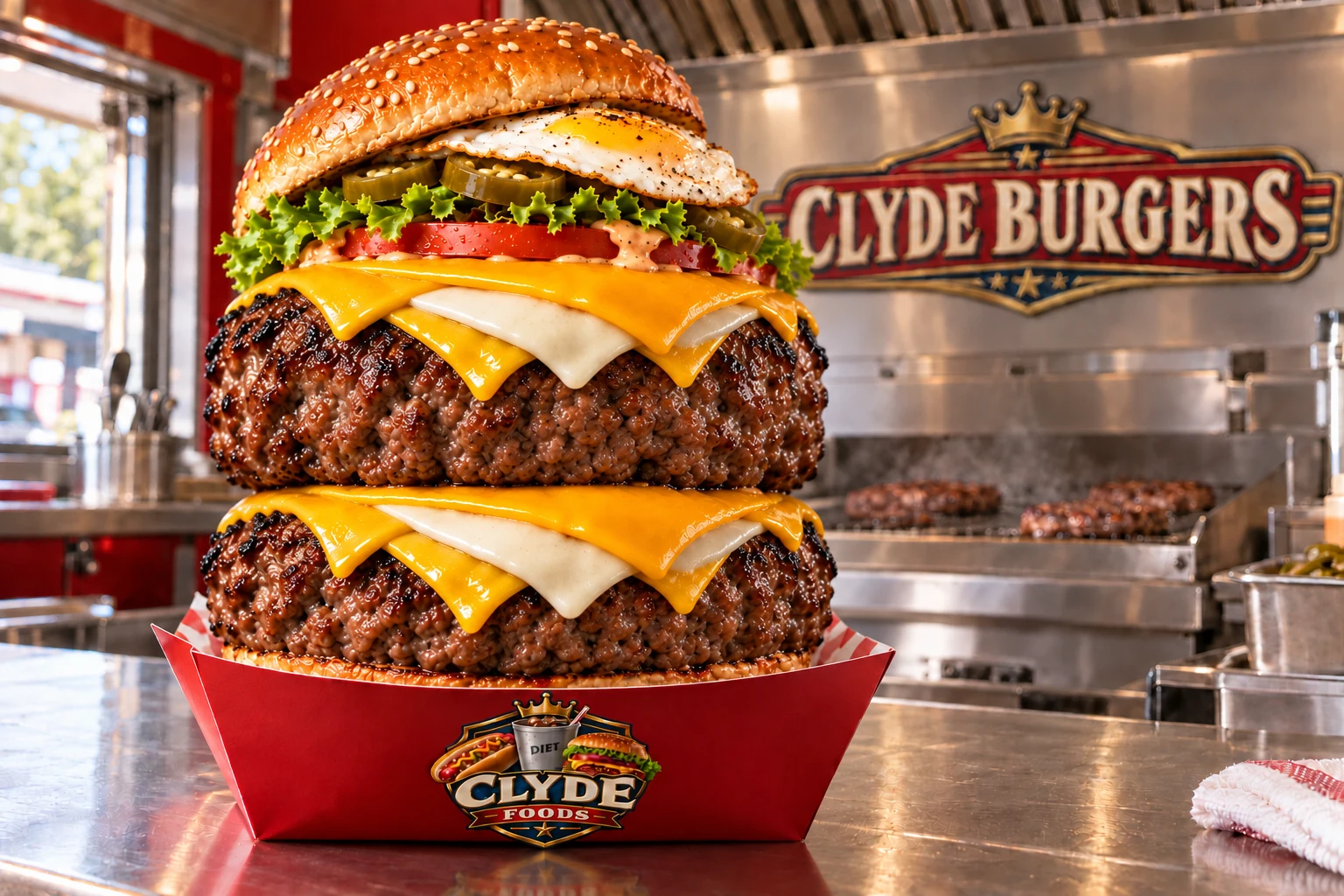
A Clyde Burger takes up real estate before it ever reaches the bun. Two eight-ounce patties need room to brown; six slices of cheese need time to melt; the egg has to arrive hot. A crowded plate makes all three harder.
This is a practical development method for a 48-inch flat-top griddle with a separate 24-inch charbroiler. Start with a small wave, keep each ticket’s two patties together, and build only when the beef, cheese and egg are ready.
Kitchen-development note: The recipe quantities below are fixed; cooking times and capacity are starting estimates for trials, not results from a tested Clyde service line. Confirm them on the actual equipment before service.
01 / MISE EN PLACE
Count it before you fire it.
For one burger
- Two 8 oz / 227 g grass-fed beef patties, 85/15 or leaner, meeting the Clyde beef standard. Form each roughly 5 inches across and ¾ inch thick; measure your actual patties for the griddle plan.
- Six consistently cut cheese slices. Use the approved cheese selection and slice weight; keep two groups of three cold until needed.
- One large egg, one substantial burger bun, and a little neutral cooking oil.
- Washed, dried lettuce; sliced tomato; drained jalapeños; Clyde Sauce; salt and pepper or the approved burger seasoning.
Cheese varieties, sauce formula and topping portions remain development choices. The six-slice count is the standard here; it does not disclose a proprietary cheese blend.
Set the truck line
- Run ventilation and preheat according to the equipment manual. Keep the grease channel clear.
- Set out a scale, surface-temperature probe, calibrated thin-tip food thermometer, wide turner, separate egg turner, scraper, and clean melting covers.
- Keep raw-beef tools and trays separate from cooked-food and assembly tools. Wash hands and change gloves after raw beef or shell-egg handling.
- Keep beef, cheese, cut produce and perishable sauce refrigerated; this workflow uses a 41°F-or-below cold station. Pull only the wave being cooked.
- Stage packaging and tickets at the clean pass. Keep shell cracking and raw-meat staging away from the bun and produce area.
02 / SURFACE MANAGEMENT
Six burgers. Twelve patties.
Room for the eggs.
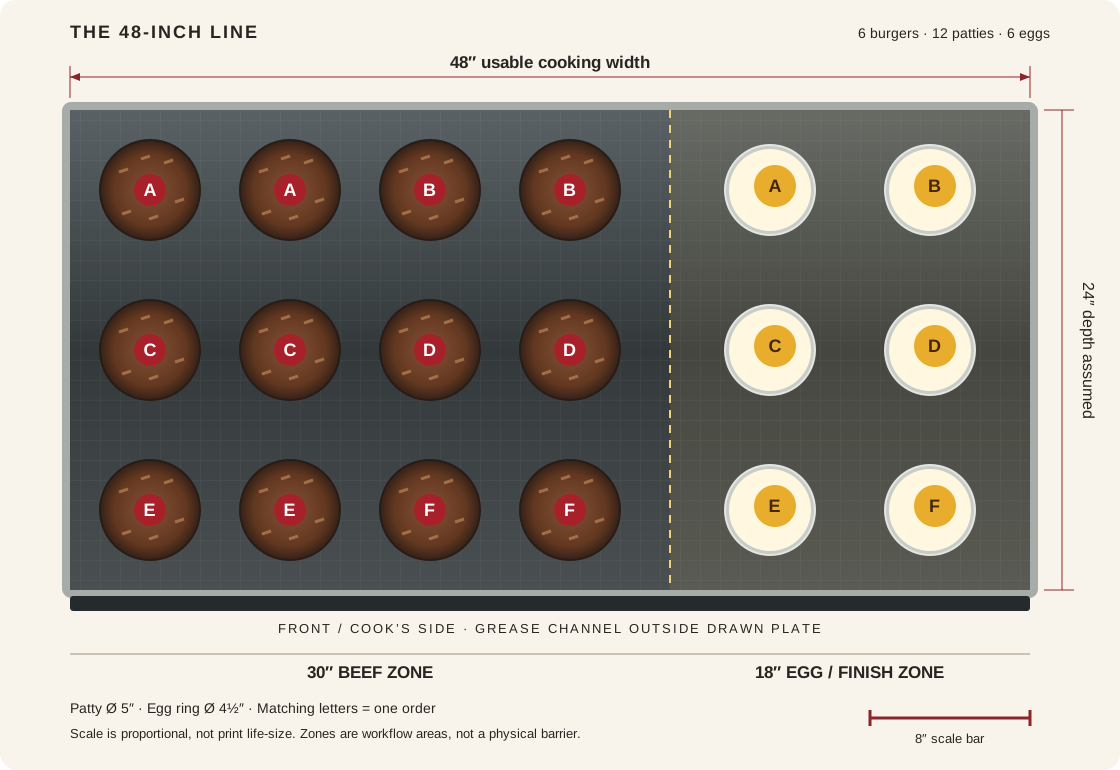
The drawing gives 30 inches to beef and 18 inches to eggs and finishing. Twelve patties make six double burgers—not twelve burgers. Letters A–F pair two patties with one egg so the cook can read the tickets directly from the plate.
What fits—and what to start with
Start a solo cook at four burgers: eight patties and four eggs. The drawing shows the next trial: six burgers in progress, with a second person assembling and handing off. Six is a layout-based working batch, not a certified maximum.
At full layout, each beef row has four 5-inch patties with 2-inch side-to-side gaps. Rows have 3-inch gaps. Six 4½-inch egg rings fit in the right zone; check your rings’ handles and actual outside diameter. Melting covers and turner access also have to fit.
Measure the plate, not the nameplate
A “48-inch griddle” may describe the appliance width. Measure usable hot steel inside the splashguards, excluding the grease trough. This plan assumes a true 48 × 24-inch cooking area. A smaller surface, larger patties or cooler edge zones means fewer orders.
The 24-inch charbroiler is separate and is not included in this capacity. It can support other menu work. Toast buns on a dedicated toaster; alternatively toast them in a clean bread-only area before raw meat is loaded. Never put ready-to-eat bread into raw-meat drippings.
The zone line is an operating map, not a splash barrier or an allergen barrier. Keep raw beef and its juices in the beef area; use separate clean egg tools. Independent controls may help, but heat travels across the plate. If the egg side cannot run cooler, use a separate suitable egg pan or reduce the load.
03 / FROM COLD PATTY TO THE WINDOW
The cook, step by step.
Use the clock to coordinate. Use the thermometer to decide when food is done.
BEFORE THE TICKET
Heat, measure, then stage.
Use 375°F on the beef zone and 325°F on the egg zone as initial surface-temperature targets for testing. Check the steel with a suitable surface probe, not just the dial. Lightly oil if needed. Start with fully thawed, chilled patties. Form gently to the same thickness and make a shallow center dimple; do not compress them into dense pucks.
FIRE THE ORDER
Season two patties and lay them down as a pair.
Season both sides immediately before cooking using the same measured dose every time. For a first kitchen trial, start with about ½ teaspoon fine salt total per burger’s pound of beef, plus pepper; taste and standardize before service. If using a salted seasoning blend, account for its salt instead. Lay the patties away from you into their assigned positions. Load back-to-front, left-to-right, and remember that order for turning and checking.
FIRST SIDE · START CHECKING AROUND 4–5 MINUTES
Let a crust develop.
Leave the patties in contact with the steel until the underside is deeply browned and releases with a firm scrape of the turner. Do not press out the juices. These are thick half-pound patties, not smash burgers. If the underside burns before the middle heats, lower the heat; if the meat sits in a puddle, reduce the batch and let the surface recover.
TURN · THEN COOK THE SECOND SIDE
Flip in the same order; check the center.
Slide the turner fully under each patty and flip without tearing the crust. Allow roughly another 4–6 minutes as an initial planning window, then continue as needed. Insert a sanitized thin-tip thermometer horizontally through the side into the center of each patty. This guide uses 160°F minimum internal temperature for ground beef. If below target, keep cooking, turn again if needed, and recheck. Never use color or elapsed time as the release test.
WHEN THE BEEF IS NEARLY READY
Fry the egg and toast the bun.
Start the egg when the patties are approaching their measured finish, using your trial cook to learn the overlap. Lightly oil the clean egg zone or an oiled 4½-inch ring. Crack one egg into a small clean cup, check for shell, then pour it onto the plate. Cook until the white holds, remove the ring when it releases, and gently turn the egg to finish with the white and yolk set. Allow roughly 3–4 minutes as a starting estimate, adjusting to actual doneness and temperature.
For shell eggs cracked to order and served immediately, FDA guidance specifies 145°F for 15 seconds. This build uses a fully cooked fried egg; verify the process with a suitable thin probe. Meanwhile, toast the bun cut-side down until golden in the clean bread station, typically 30–60 seconds. Keep it ready for immediate assembly.
BEEF VERIFIED AT 160°F
Melt three slices on each patty.
Lay the slices slightly offset so their corners soften over the beef. Cover each patty, or its pair, with a clean melting cover that fits the assigned space. Check after 30–60 seconds; allow longer if the approved cheese needs it. Lift the cover away from your face. The cheese should relax onto the meat with no cold, stiff center. Keep the patties separate until both are done and both cheese stacks have melted.
If the cheese consistently needs a long covered finish, test thinner slices or a better-melting selection at the same approved portion weight. Do not improvise the cheese count during a rush.
AT THE CLEAN ASSEMBLY STATION
Build from the bottom up.
Use this repeatable trial stack: toasted bottom bun → Clyde Sauce → first patty with three cheese slices → second patty with three cheese slices → tomato → dry lettuce → drained jalapeños → fried egg → top bun. Keep the sauce modest enough that the bun still grips. Center the patties and support the egg with a clean turner. Bring refrigerated produce out only for the build; do not warm it on the griddle.
FINISH & RESET
Count, support, send.
Check the ticket and the build: two patties, six slices, one egg, correct modifications. Set the burger in a deep tray with a loose paper collar that supports the bottom and catches drips without crushing the egg. Serve immediately. Scrape the cleared beef zone into the grease channel without pushing juices into the egg area, clean tools as required, and let the surface return to its target before loading the next wave.
The two temperature checks
Beef: 160°F in each patty. The USDA endpoint used here is a simple, conservative house target. Egg: 145°F for 15 seconds when cracked to order for immediate service. FDA specifies 155°F for 17 seconds for raw shell eggs not broken for immediate service. This workflow does not pool eggs or hold cooked eggs for later tickets. Local commercial-food requirements govern the final operating procedure.
USDA: Ground Beef and Food Safety ↗ FDA: Egg Safety Temperatures ↗
04 / RUNNING THE WAVE
Keep the finish together.
| Phase | Griddle cook | Assembly / pass |
|---|---|---|
| Load | 12 chilled patties, in pairs A–F. Note the start order. | Read six tickets; stage six buns and packages. Keep toppings cold. |
| Turn | Turn in loading order. Start center-temperature checks. | Group 36 cheese slices as twelve sets of three; keep refrigerated until needed. |
| Finish | Fire six eggs as beef approaches done. Verify beef, then add cheese and cover. | Toast buns just ahead of assembly; sauce and dress to ticket. |
| Send | Release each pair only after its temperature check; send its egg with it. | Stack, count and hand off each burger as ready. Do not wait to photograph all six. |
| Recover | Clear debris; restore surface heat before the next load. | Reset the clean pass and reconcile the next tickets. |
How many can be going at once?
Four is the starting trial for one cook; six is the illustrated wave for a cook plus an assembler. All six can occupy the plate at the egg-finishing stage shown. Bun toasting happens elsewhere. You can stagger two-order groups after testing recovery, but do not add a new raw-beef load while it disrupts the current wave’s eggs, temperature checks or assembly.
Capacity is not an hourly promise.
Time the complete cycle from loading through recovery. The arithmetic is burgers per wave × 60 ÷ full cycle minutes. For example, six burgers on a measured 15-minute cycle would be 24 per hour before delays. That is an illustration, not a Clyde production claim; payment, fries, modifications and staffing can lower the real rate.
Before calling the method ready
Run repeated four-burger trials, then six with an assembler. Record raw patty diameter and thickness, cheese weight, loaded surface temperatures, every patty’s endpoint, egg finish, time to the window and recovery time. Keep the larger wave only if browning, safe endpoints and handoff quality hold through consecutive cycles.
Milk, egg and wheat are inherent in this build; sauces and purchased ingredients may add allergens. Use supplier ingredient information and a reviewed allergy-order procedure. A griddle zone or scrape alone does not make a shared cooktop allergen-free.